AI Will Copy Everything Except Bitcoin
The Bridge Between Physics and Cyberspace.


There’s a question that most people aren’t asking yet, but they will be soon. It goes like this: in a world where artificial intelligence can generate anything digital, text, images, video, even entire identities, what’s left that you can actually trust?
It’s a real question. And the answer, I think, is hiding in plain sight.
But to get there, we need to start somewhere unexpected. We need to start with chemistry.
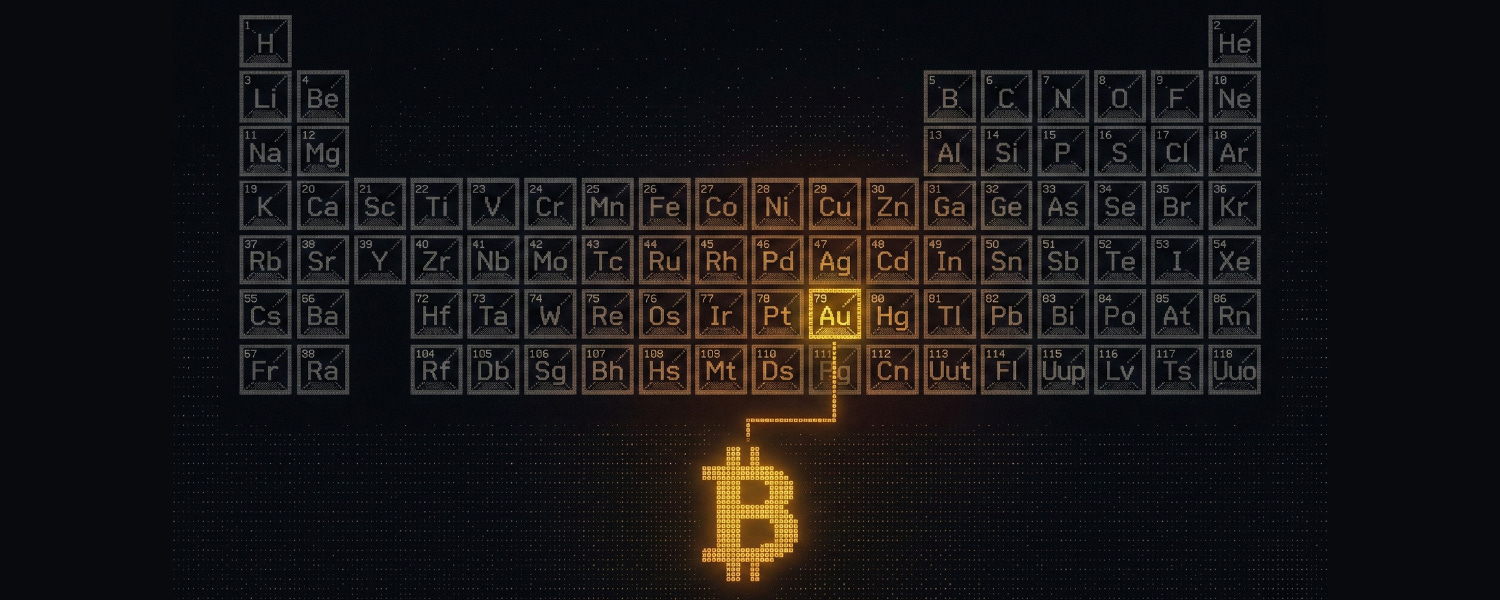
The Periodic Table Already Answered This Question
Here’s something fascinating that most people don’t know. The reason gold became money wasn’t a cultural choice. It wasn’t because some king decided it looked pretty. It was chemistry. Physics. The actual properties of the elements themselves.
Sanat Kumar, a Professor of Chemical Engineering at Columbia University, walked through this on NPR’s Planet Money, and it’s one of the cleanest thought experiments I’ve ever heard. He started with all 118 elements on the periodic table and just started eliminating.
Noble gases? Gone. You could have your money in a jar, but then if you open the jar, you’re broke. Reactive metals like lithium? Out. Expose lithium to air and it causes a fire that can burn through concrete walls. Radioactive elements? They’d kill you. The lanthanides and actinides all look the same, like metal shavings, so you can’t tell them apart. Mercury and bromine are liquids at room temperature. Not exactly pocket money.
After you eliminate gases, liquids, reactive metals, radioactive elements, and look-alike rare earths, you’re left with just a handful of noble metals. Silver tarnishes. Platinum melts at 1,770°C, which was unworkable for ancient civilizations. Rhodium and palladium weren’t even discovered until the 1800s.
And then there’s gold.
Gold melts at 1,064°C, accessible to ancient bellows and charcoal. Its density of 19.32 grams per cubic centimeter made counterfeiting nearly impossible. It’s the most malleable metal known, one gram can be beaten into a full square meter of gold leaf. Its unique yellow color, caused by relativistic effects on its electron orbitals, made it instantly identifiable. It doesn’t react with air, water, or most acids. Coins buried for millennia emerge looking the same.
Kumar’s verdict? “For the Earth, with every parameter we have, gold is the sweet spot. And it would come out no other way.”
Here’s the thing. People didn’t sit in a committee and vote on gold. Egyptians, Lydians, Persians, Romans, they all arrived at the same answer independently. Different continents. Different centuries. Same element. Carl Menger, the Austrian economist, formalized this in 1892: money isn’t generated by law. It emerges naturally from market behavior. The most saleable commodity, the one with the highest marketability across time and space, naturally becomes money.
But the property that matters most isn’t the shininess or the malleability. Nick Szabo identified it in his foundational 2002 essay Shelling Out. He called it unforgeable costliness. Gold is expensive to produce and impossible to fake. A gold bar can be chemically tested to confirm it’s real, and the cost of extracting it from the earth cannot be conjured out of thin air.
As Szabo put it on the Tim Ferriss Show: “There’s something about what I call the unforgeable costliness of it. The scarcity of it, the naturally trust-minimized scarcity of it. You don’t have to trust somebody to keep it scarce.”
You don’t have to trust somebody. That’s the key line. Gold’s scarcity isn’t maintained by a central bank or a government or a committee. It’s maintained by the laws of nuclear physics. All the gold ever mined, roughly 244,000 metric tonnes, would fit in a 22-meter cube. Annual production adds only about 1.5 to 3 percent to existing stocks. Even a gold rush that doubles annual production barely moves the needle.
Gold worked for thousands of years. Until we needed to send value at the speed of light.
The Bridge Between Physics and Cyberspace
Szabo saw the problem clearly. In his 2005 Bit Gold proposal, he wrote: “Precious metals and collectibles have an unforgeable scarcity due to the costliness of their creation. This once provided money the value of which was largely independent of any trusted third party. But you can’t pay online with metal. Thus, it would be very nice if there were a protocol whereby unforgeably costly bits could be created online.”
Bitcoin was that protocol.
And here’s where it gets interesting. Bitcoin’s proof-of-work mechanism doesn’t create digital scarcity through software rules alone. It creates it through physics. Real energy. Real electricity. Real thermodynamic work that cannot be faked, reversed, or simulated.
The mechanism is deceptively simple. Miners use specialized hardware to perform SHA-256 hash computations, searching for a value that produces a result below a target threshold. Because hash functions are one-directional, the only method is brute-force trial and error. The solution is trivially easy for anyone to verify, a single computation, but impossibly expensive to produce without doing the actual work. Hard to produce, easy to verify. Sound familiar? That’s the same asymmetry gold has. Hard to mine, easy to assay.
Hugo Nguyen put it beautifully: “When Satoshi designed PoW, he was fundamentally changing how consensus between humans is formed from political votes to apolitical votes via the conversion of energy. PoW is about physics, not code. Bitcoin is a super commodity, minted from energy, the fundamental commodity of the universe.”
Let me put it this way. Right now, Bitcoin’s network is performing approximately one zettahash per second. That’s one sextillion SHA-256 computations every single second. The network consumes roughly 170 to 180 terawatt-hours annually, comparable to a mid-sized country. Mining infrastructure exceeds 16 gigawatts of capacity. Each block represents approximately 10.14 petajoules of thermodynamic work, energy that has been irreversibly expended and cannot be conjured by consensus, forgery, or decree.
That cumulative energy creates what researchers call thermodynamic write-once memory. To alter a transaction buried six blocks deep, an attacker would need to redo all proof-of-work for those blocks while simultaneously outpacing the entire honest network. One estimate put the cost of a sustained 51% attack at roughly $6 billion, and that doesn’t account for the practical impossibility of secretly acquiring that much hardware.
Michael Saylor articulated maybe the most elegant version of this argument: “If you live in a universe where the laws of thermodynamics hold, there’s a rate at which heat dissipates everywhere in the world. Bitcoin, because it’s working in the physical world, it absorbs all of the physical constants in the universe.”
This is the fundamental distinction. Proof-of-work inherits the security of the entire physical universe for free. Any system that tries to replicate this security in pure software is, as Saylor puts it, “literally playing God and forgetting one thing.” That forgotten thing is always what breaks the system.
The Flood Is Already Here
Now here’s where it all connects.
We’re living through an information explosion unlike anything in human history. And it’s not slowing down. An Ahrefs study analyzing 900,000 new web pages found that 74.2% contained AI-generated content. Europol’s Innovation Lab warned that up to 90% of online content may be synthetically generated by 2026. The Imperva 2025 Bad Bot Report found automated systems accounted for 51% of all web traffic in 2024, the first time bot traffic surpassed human traffic.
The dead internet theory isn’t a conspiracy anymore. It’s a data point.
Deepfakes are scaling even faster. Deepfake files surged from 500,000 in 2023 to a projected 8 million in 2025, a 900% annual growth rate. Identity fraud attempts using deepfakes surged 3,000% in 2023. In February 2024, a finance worker at British engineering firm Arup was deceived by a deepfake video conference impersonating the CFO, losing $25 million. Only 9% of adults feel confident they can identify a deepfake.
But the deepest problem isn’t just fake content. It’s what law professors Robert Chesney and Danielle Citron called “the liar’s dividend.” The mere existence of deepfakes allows anyone to dismiss authentic evidence as fake. Research from Yale involving over 15,000 adults confirmed that politicians’ claims of misinformation increase their support across partisan subgroups. When everything can be faked, nothing can be trusted. And that doubt itself becomes a weapon.
Nina Schick, author of Deepfakes: The Coming Infocalypse, framed it plainly: “Anyone can be targeted, and everyone can deny everything.” Aviv Ovadya, who coined the term “Infocalypse” in 2016, asked the central question: “What happens when anyone can make it appear as if anything has happened, regardless of whether or not it did?”
This is the world AI is building. Not intentionally. Not maliciously. Just as a natural consequence of making digital creation essentially free.
The One Thing AI Cannot Fake
Here’s the critical insight, and it’s the whole point of this piece.
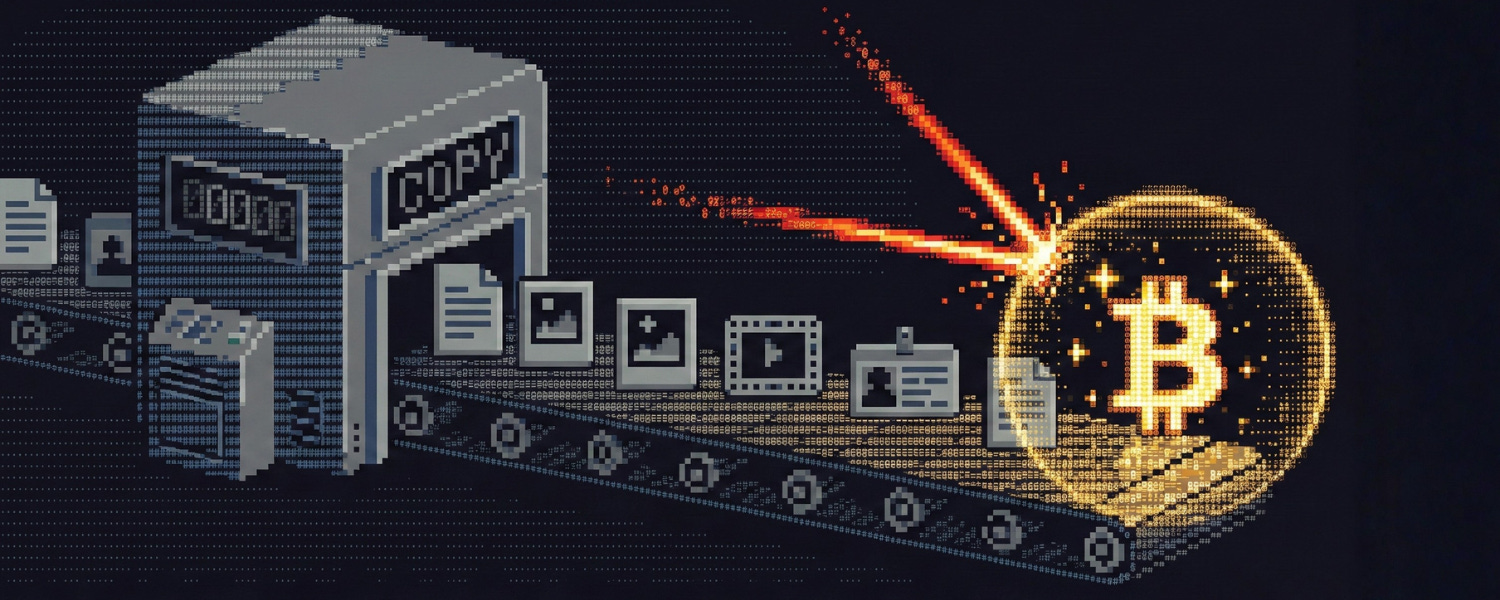
AI can generate anything digital except proof-of-work.
Think about that. AI produces perfect text, photorealistic images, convincing video, functional code, synthetic identities. It can generate a flawless deepfake of anyone saying anything. It can write code that writes code. It can create entire websites, entire personas, entire histories.
But it cannot generate a valid Bitcoin block hash without actually expending the energy.
SHA-256 is a one-way function. No amount of pattern recognition, training data, or neural network architecture can predict its output. There is no shortcut. The hash is pseudorandom. You must compute it to know it. This means proof-of-work is not information, which AI can copy, but proof of thermodynamic work, which AI cannot fake.
In a world of infinite digital simulations, proof-of-work provides what one researcher called “a magnetic North of digital truth that was too costly to lie about.”
This is why Bitcoin isn’t just money. It’s a truth layer. It’s the base layer of verifiable reality in a digital world where everything else can be hallucinated, fabricated, or simulated. And this is exactly what Ben Horowitz is pointing at.
The Missing Network Layer
In a February 2026 interview, Ben Horowitz laid out his clearest articulation yet of why AI needs crypto. His framing was structural: “Networks and computers tend to grow together, and I think that AI is obviously a new kind of computer and crypto is a new kind of network.”
Just as the iPhone needed the Internet, AI needs a network layer. And Horowitz went further: “I think there needs to be not just a ledger of money, but probably a ledger of truth for AI to really fulfill its potential.”
A ledger of truth. That’s the phrase that matters.
Now, Horowitz says “crypto” broadly. But let’s think about what a ledger of truth actually requires. It needs to be incorruptible, meaning no single party can alter it. It needs to be verifiable without trusting anyone. It needs to be anchored in something outside the digital realm, because if truth is defined only by digital consensus, AI can manipulate that consensus. It needs unforgeable costliness.
There’s only one system that meets all of those criteria. The same way gold emerged from the periodic table as the only viable monetary metal, Bitcoin emerges from the digital landscape as the only viable truth layer. Lowest entropy. Highest order. Highest integrity. The most pure, just as gold was once chosen.
And the practical infrastructure is already being built. AI agents can’t open bank accounts. They can’t get credit cards. They don’t have Social Security numbers. As Horowitz noted: “An AI can’t get a bank account. You have to be a human for everything.” But AI agents can interact with Bitcoin and crypto rails. The x402 protocol, launched by Coinbase in 2025, revived the dormant HTTP 402 “Payment Required” status code to embed micropayments directly into HTTP requests, processing over 100 million payments in its first six months. Lightning Labs released an AI Agent Toolkit enabling autonomous Bitcoin Lightning payments. The infrastructure for machine-to-machine value transfer is being built on Bitcoin’s rails right now.
Bitcoin Is the TCP/IP of Value
The analogy isn’t new, but it’s never been more relevant. Marco Iansiti and Karim R. Lakhani argued in Harvard Business Review that blockchain is a foundational technology, not merely disruptive, that would follow TCP/IP’s multi-decade adoption curve. Andreas Antonopoulos coined it most sharply: “Bitcoin is the internet of money. Currency is only the first application.”
Think about how the internet works. TCP/IP is the base layer. It’s slow, it’s simple, it routes packets regardless of content. Nobody “uses” TCP/IP directly. They use applications built on top of it: HTTP for websites, SMTP for email, HTTPS for secure connections. But every single application ultimately settles down to TCP/IP.
Bitcoin works the same way. The base layer processes roughly 7 transactions per second with 10-minute block times, deliberately conservative, optimized for security and decentralization over throughput. The Lightning Network enables near-instant, near-free transactions. The Liquid Network offers 1-minute blocks for institutional traders. Applications like stablecoins, AI agent payments, and tokenized assets all function on layers above.
But they all settle to the base layer. And the base layer is secured by proof-of-work. By physics. By energy that cannot be faked.
Don Tapscott, who originally titled his book Blockchain Revolution as The Trust Protocol, identified the core gap: “The great missing element in the Internet has been a trust protocol, a way of knowing that a transaction is verified and authentic.” Bitcoin provides that missing protocol.
Bitcoin has maintained 99.986% uptime since January 3, 2009. No transaction has ever been reversed. No hard fork has overwritten its history. Fifteen years of unbroken operation is the longest continuous demonstration of digital trust ever achieved.
AI Without Bitcoin Is Just Faster Fiat
Jeff Booth put it most sharply: “AI plus fiat equals centralization. AI plus Bitcoin equals freedom.”
His reasoning is precise. Technology naturally creates abundance and drives prices toward zero. But under fiat systems, those deflationary gains are captured through money printing. AI makes everything more productive, but if the money system is broken, that productivity gets extracted from you. Bitcoin, with its fixed supply and proof-of-work security, lets the abundance flow to everyone.
Balaji Srinivasan, former CTO of Coinbase, maps the structural opposition: “AI is digital abundance, but it doesn’t make everything abundant. Crypto is digital scarcity and complements AI’s abundance.” His bluntest formulation: “Cryptocurrency is what’s provably scarce in the age of AI abundance.”
And that’s really the whole thesis. AI creates infinite digital abundance. But abundance without a truth anchor is just noise. It’s a firehose of content with no way to verify what’s real. It’s a million AI agents transacting with no incorruptible settlement layer. It’s digital chaos.
Bitcoin provides the anchor. Not because anyone decided it should. But because, just like gold in the physical world, it emerged from a process of elimination. It’s the only digital system anchored in physics rather than trust. The only system that converts real energy into immutable truth. The only base layer that AI cannot hallucinate, manipulate, or fake.
The periodic table gave us one element that could serve as money. The digital realm, by the same process of elimination, is converging on one protocol that can serve as truth.
The energy isn’t a bug. It’s the feature. It’s the unforgeable cost that separates signal from noise, settlement from promise, truth from hallucination.
In the age of infinite copies, the scarce thing wins. And the scarcest thing in the digital world is proof that real work was done.
That’s Bitcoin. That’s the missing layer.
Study Bitcoin.
This is the crux of something important. AI can generate code, replicate art styles, write essays, synthesize music — but it can’t generate provable scarcity. The 21 million cap isn’t a design choice someone can overwrite with better training data. Bitcoin’s value proposition has always been the one thing digital systems struggle to fake: authentic finality. You can train an AI on every economics paper ever written and it still can’t conjure up a new Bitcoin. The convergence of AI abundance and Bitcoin scarcity might be the most important asymmetry of this decade.
Hey, Bram, wat een geweldig artikel is dit. Ik heb natuurlijk ook de boeken van Andreas Antonopoulos, Don & Alex Tapscott, Jeff Booth, etc. gelezen. Maar... dit brengt het wel mooi samen, en het geeft een klare kijk op de relatie tussen bitcoin en A.I. Knap!